

Brain Injury Lawyers Serving Olympia & Tacoma
Can you suffer a brain injury without hitting your head?
Yes. A person can suffer a traumatic brain injury (TBI) without first striking their head. A violent impact to the body can cause the head to move rapidly forward, backward, or from side to side, allowing the brain to bounce or twist inside the skull. This sudden motion can cause what’s called an acceleration-deceleration injury.
Non-contact brain injuries can occur during:
- A rear-end collision
- A high-speed car or truck crash
- A motorcycle accident
- A bicycle or pedestrian accident
- A sporting event
- A serious fall
- An incident involving forceful shaking or rotation
Unfortunately, these injuries might be overlooked on the scene of an accident in the absence of a cut, bruise, skull fracture, or other obvious wound. However, symptoms such as headaches, confusion, dizziness, memory problems, mood changes, or poor concentration may still indicate a brain injury.
At Fuller & Fuller, our Washington brain injury lawyers understand that an injury doesn’t have to be visible to be real. We can investigate how the accident occurred, consult with appropriate medical professionals, and help connect the forces involved in the accident with the symptoms that have followed.
Can you have a traumatic brain injury even if your CT scan or MRI is normal?
Yes. A normal CT scan or MRI doesn’t necessarily rule out a concussion or another mild traumatic brain injury.
CT scans are particularly useful for detecting urgent conditions such as skull fractures, bleeding, swelling, and blood clots. A CT scan isn’t generally needed to identify a mild TBI or concussion, although it may be ordered if doctors are concerned about bleeding or another complication.
MRI scans can provide more detailed images of the brain’s soft tissue. Even so, routine imaging may not reveal microscopic damage, chemical changes, or injuries involving stretched brain cells.
Doctors may diagnose a concussion by considering:
- The accident and the forces involved
- Your reported symptoms
- Physical and neurological examinations
- Changes in memory, concentration, and problem-solving
- Balance, coordination, vision, or speech problems
- Neuropsychological or neurocognitive testing
- Observations from family members, friends, and others
In some cases, doctors may use advanced MRI techniques to investigate injuries that don’t show clear abnormalities on a routine scan.
Unfortunately, in these situations, insurance companies may point to a “mild TBI” diagnosis or a “normal” scan as proof that nothing serious has happened. But this ignores or minimizes the potential for issues like persistent post-concussive symptoms, which can interfere with your ability to work, interact with friends and family, and pursue the things in life that bring you joy.
The Olympia brain injury lawyers at Fuller & Fuller know how even a minor TBI can have major impacts. We look at the complete body of evidence, not just the results from a single scan, to truly see how your injury has affected your independence and quality of life.
Do you have to lose consciousness to have a traumatic brain injury?
No. Loss of consciousness can be a sign of a traumatic brain injury, but it might not occur following mild TBI or concussion.
Some people never black out. Others experience a brief change in consciousness without realizing it at the time. They may feel stunned, dazed, disoriented, unusually tired, or unable to remember what happened immediately before or after the accident.
Possible signs of a brain injury without loss of consciousness include:
- Confusion or mental fog
- Difficulty concentrating
- Short-term memory problems
- Headaches
- Dizziness or poor balance
- Nausea
- Sensitivity to light or noise
- Blurred vision
- Irritability or unusual emotional reactions
- Changes in sleep
- Slowed thinking or speech
When you’re involved in an accident, you may believe you’re simply “shaken up.” The adrenaline and confusion of an accident can make symptoms difficult to recognize. That’s why it’s important to seek medical care and explain any changes you’ve noticed, even if you remained conscious throughout the incident.
At Fuller & Fuller, our Tacoma brain injury lawyers take these injuries seriously. We listen closely to the changes you’ve experienced to fully understand what your injury has taken from you.
What if my brain injury symptoms didn’t appear until days after the accident?
Delayed symptoms are common after certain TBIs. Some brain injuries take hours or days to show noticeable symptoms. This may be because you’re focusing on more pressing issues like broken bones. It can also be due to shock, which can impact your ability to notice changes in thinking, memory, or mood.
Delayed symptoms of brain injury may include:
- Headaches that persist or grow worse
- Difficulty concentrating at work
- Forgetting conversations or appointments
- Feeling mentally slowed down
- Irritability, sadness, and anxiety
- Sleeping too much or too little
- Sensitivity to noise or bright light
- Dizziness or balance problems
- Unusual fatigue
- Changes noticed by family members
You should always seek medical care after an accident. If you’ve not and these symptoms have appeared, the time to seek medical care is now. Worsening headaches, repeated vomiting, seizures, slurred speech, severe confusion, unusual behavior, or difficulties walking may require emergency treatment.
It can help to document when each symptom begins and how it interferes with daily activities.
The Washington brain injury attorneys at Fuller & Fuller know that delayed symptoms don’t make an injury any less serious. We can help detail the timeline, preserve medical evidence, and work to show how your accident caused the symptoms you’re currently experiencing.
Can a brain injury settlement include future medical care and rehabilitation?
Yes. When an accident causes a brain injury, a claim may include the reasonable value of medical care, treatment, and rehabilitation that you’re likely to need in the future.
Depending on the severity of the injury, this may include:
- Physical therapy for strength, movement, and balance
- Occupational therapy for everyday tasks
- Vocational rehabilitation
- Speech-language therapy for communication or swallowing problems
- Cognitive rehabilitation for memory, attention, and problem-solving
- Psychological or neuropsychological treatments
- Prescription medications
- Mobility and adaptive equipment
- Home healthcare or attendant care
- Residential or skilled nursing care
Brain injury rehabilitation often requires a coordinated effort between a team of medical and therapeutic specialists. Treatments may continue for months or even years without the guarantee of full recovery. Some people may require ongoing outpatient, home-based, or residential care despite treatment efforts.
Future care claims need to be supported by treatment records, medical options, rehabilitation plans, life-care planning, expert testimony, and evidence showing that symptoms and limitations are continuing.
Once a claim is settled, it might be too late to go back and request additional compensation, even if treatment is more expensive than anticipated. It’s important to understand the likely long-term impact before accepting a final resolution.
At Fuller & Fuller, we take the time to understand what comes next. Our Olympia brain injury attorneys work to build claims that account for the future, so families aren’t left carrying the financial burden of care that should have been considered from the beginning.
How much is a traumatic brain injury claim worth in Washington?
There isn’t a trustworthy “average” value for a brain injury claim. These injuries affect people differently. Two individuals with the same diagnosis might have very different treatment needs, work limitations, and long-term outcomes.
Things that can impact the value of a brain injury claim include:
- The severity and permanence of the injury
- Past and future medical costs
- Lost income and earning capacity
- The effect on daily life
Be cautious of online settlement calculators and lawyers who point to a specific number before reviewing the evidence. A brain injury claim can’t be valued fairly by multiplying medical bills or looking at a diagnosis alone. How the injury has changed your health, independence, career, relationships, and future also need to be considered.
The Tacoma brain injury attorneys at Fuller & Fuller take time to understand the complete story. We work with clients, families, medical providers, and qualified experts to pursue compensation that reflects both the losses already suffered and the challenges that may lie ahead.
Auto and motorcycle accidents are the main causes of brain injury in Washington state.
If you’ve been in an accident and:
- Your head was hit
- Your neck and spine jarred
- You lost consciousness, even for a few moments
- You experienced some kind of changed consciousness
- You experienced post-traumatic amnesia (confusion or forgetting)
then you may have a brain injury.
Traumatic Brain Injury (TBI)
The brain can be injured whether or not the skull is penetrated. Presumably, if your head was bleeding, you received medical attention. But even if no wound was visible on your head, your brain may still have been injured.
Closed head injury
This happens when the head is suddenly stopped while in motion, e.g. in a fall or traffic accident. The brain is brought up short against the inside of the skull. A whiplash injury can have the same effect, causing the brain to hit against the skull.
The damage to the brain can take three main forms:
Bruising
A bruise on the body is a common minor injury, but a bruise on the brain is far more serious. A bruise is torn tiny blood vessels, which create a pool of blood. When a bruise happens in the enclosed space of the skull, the pooling blood takes up some of the limited space and presses against the brain. In extreme cases, this can make the brain tissue stop functioning.
Swelling
The body senses that the brain is hurt and it sends extra blood to try to heal it. Other fluids collect too, which can further increase the pressure on the brain.
Tearing
During an accident, the brain tissue may sustain tears so small that they can’t be seen with Computer Tomography (CT scan) or a Magnetic Resonance Imaging (MRI), two of the major assessment tools used for brain injury. These microscopic tears can sever the brain’s wiring, disrupting normal brain function.
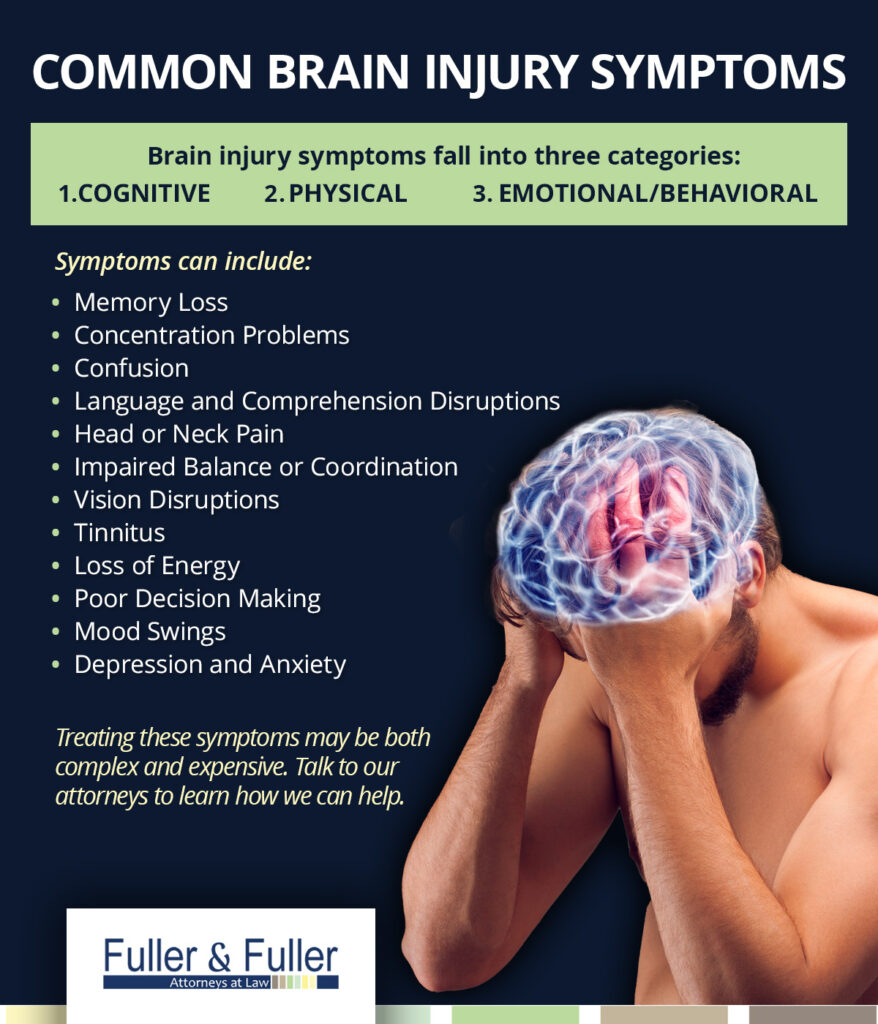
Examples of Brain Injury Symptoms
• Loss of memory • Poor concentration • Poor decision making • Head or neck pain • Confusion • Lack of energy •
• Impaired balance or coordination • Blurred or double vision • Ringing in the ears • Reduced sex drive •
• Difficulty with reading or speaking • Mood swings • Changes in sleeping habits • Loss of energy
These symptoms fall into 3 categories:
- Cognitive
- Physical
- Emotional/Behavioral
Claims can be complex
There’s still much that’s unknown about the brain and how it functions.
- The injuries can be hard to document
- Diagnostic tests don’t always provide hard proof
- Medical experts can disagree on causation, degree of impairment, or recovery
Investigation and negotiation may take some time, and require special attention and an experienced brain injury attorney. If your case goes to trial, you need a skilled lawyer to document and present all the complex information.
Contact Our Brain Injury Lawyers Today
At Fuller & Fuller, we understand how distressing things can be if you or a loved one has sustained a brain injury. Our brain injury attorneys will investigate your situation, gather the facts, and fight for your fair compensation. If you feel you or a loved one has incurred a brain injury, contact Fuller & Fuller, Attorneys, today for a free case evaluation.